
Diagnose commercial roof flashing failures in Fullerton at walls, curbs, penetrations, and edges before specifying a compatible repair.
Roof leak, storm damage or an inspection coming up?
A flashing leak can appear well away from the detail that admitted water, so the first task is to document the path rather than patch the nearest visible stain. Record the room, time, rainfall, recent mechanical work, and roof zone. The inspection then traces transitions at parapets, curbs, pipes, skylights, expansion joints, and drains, noting what is accessible and what is hidden. A failed sealant bead may signal movement or incompatible materials; adding another bead without preparation can leave the underlying termination unresolved. Fullerton's General Plan names Commonwealth Corridor and Harbor Gateway as broad planning geographies, not descriptions of a particular building. NOAA climate normals help frame seasonal scheduling but do not explain a specific leak. A sound repair scope identifies the transition, assembly, preparation, compatible detail, and follow-up evidence.
Which flashing locations deserve close examination?
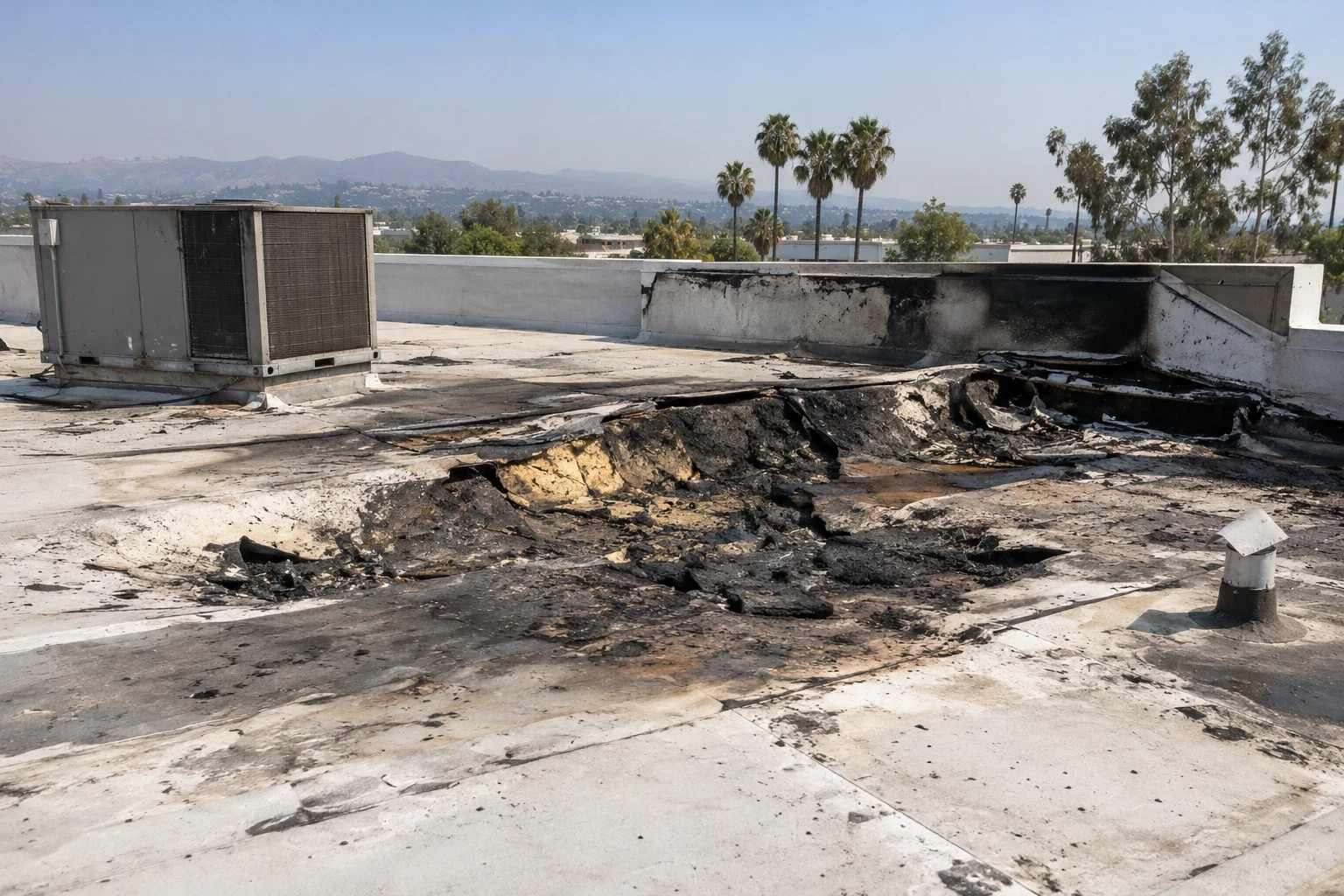
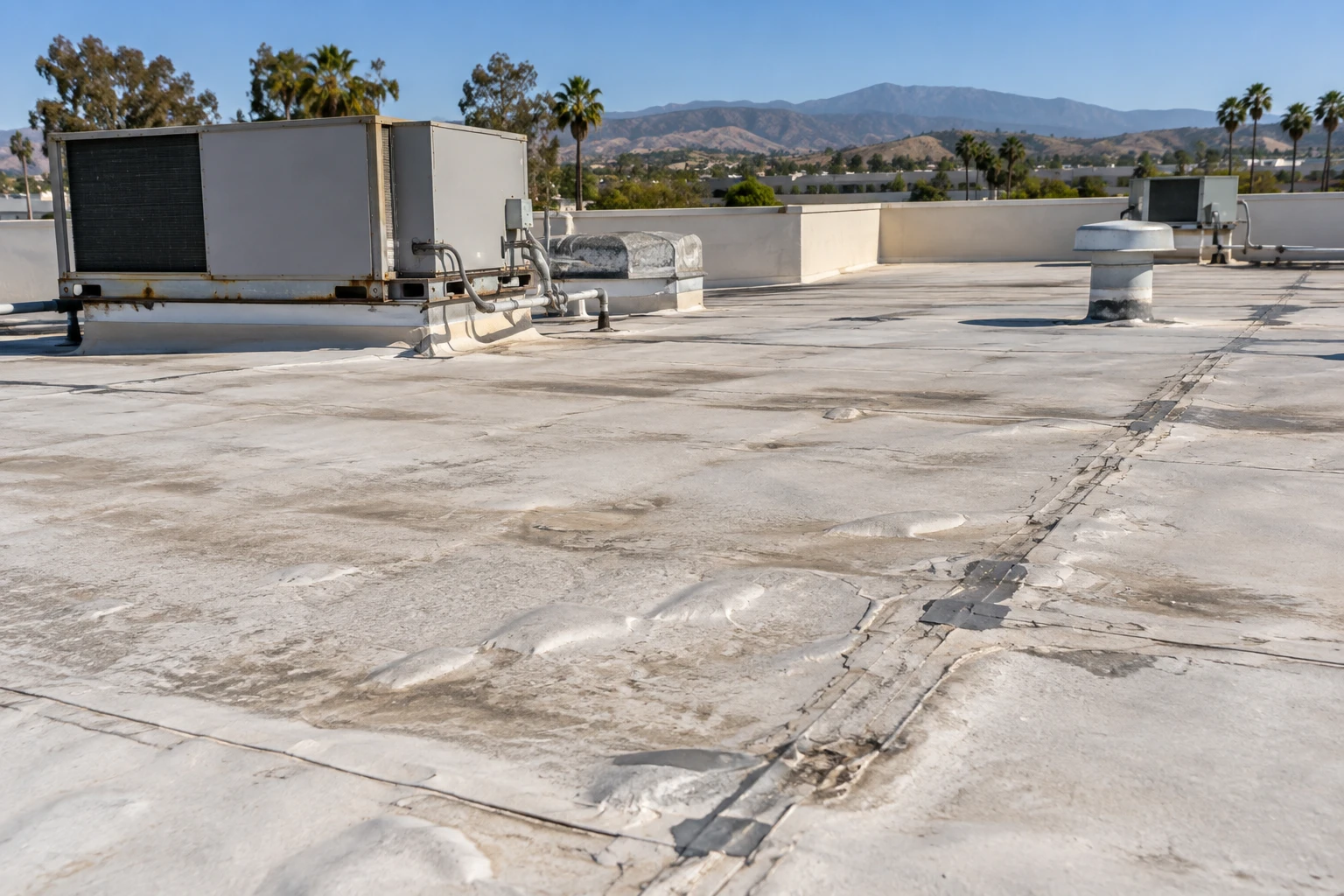
Review inside and outside corners, counterflashing, base flashing, reglets, curb corners, pipe boots, skylight frames, scuppers, and equipment supports. Look for open seams, loss of adhesion, fasteners backing out, cracked sealant, corrosion, exposed edges, and dissimilar materials in contact. Check whether wall movement or equipment vibration may affect the transition. Photograph a wide context view and a close detail, both tied to a roof-plan location. A skylight and penetration review can define that subset; coping and edge-metal inspection can distinguish sheet-metal attachment from membrane termination. Avoid diagnosing concealed conditions from a single surface image.
How should a team trace a suspected flashing leak?
Start with a building-side timeline, including rainfall direction if known and recent plumbing or HVAC service. Then compare the likely route with roof transitions, slope, drains, and wall interfaces. Water can travel under a membrane or along a deck, so the closest detail is not necessarily the entry point. If a test is needed, define its boundaries, water-control plan, and observer with the owner before proceeding. An interior leak investigation should document the method and result rather than promise a diagnosis from an untested theory. For moisture mapping, a thermal survey may help under suitable conditions, but interpretation must account for the assembly and weather history.
Why does material compatibility matter at a flashing repair?
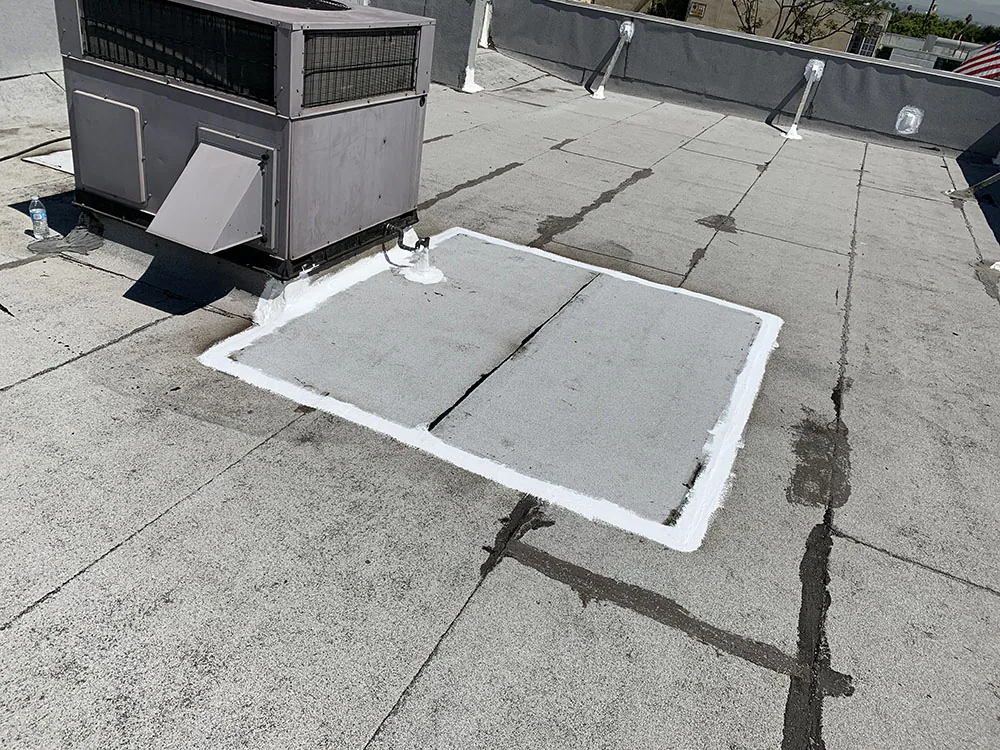
Membranes, metal, sealants, primers, and adhesives each have application requirements. Identify the existing system through records or field evidence before selecting a repair product. Check cleaning, surface preparation, cure conditions, temperature range, and whether the proposed material is allowed by the warranty. A patch should not bridge a moving joint unless the detail is designed for that movement. If a manufacturer detail applies, keep the submittal with the work order. A PVC system assessment or EPDM assembly review can inform the compatible detail, while a broad product label alone does not establish compatibility. Escalate unknown substrates instead of mixing unverified materials.
What can limit water entry while permanent work is arranged?
A temporary measure should name the affected area, material, installation date, and person who will inspect it. It should not cover an opening that still needs testing, block a drain, or create a trip hazard on an access route. Establish who can authorize removal and how the building will be notified if the temporary seal changes. The property team can protect interior contents through its own procedures while the roofer records the exterior observation. Emergency response may reduce immediate exposure, then a permanent detail should be specified after the assembly and movement are understood. A membrane puncture repair is a separate scope when the surface is damaged beyond the flashing itself.
What should a permanent flashing scope specify?
Name the detail by roof-plan location and describe removal limits, substrate condition, primer or separation layer, fasteners, membrane turn-up, metal termination, sealant geometry, and protection. State what will be replaced and what existing material will remain. If hidden deterioration appears after opening, pause and obtain authorization under a stated unit-price or change process. The closeout should include preparation and finished-detail photographs and any required cure or inspection interval. Fullerton adopts the 2025 California Building Code subject to local amendments; confirm permit requirements for the specific alteration. A commercial repair scope can be compared with full replacement planning if multiple transitions are at end of service.
How should flashing repairs be tracked over time?
Store the marked plan, photos, product documentation, weather notes, authorization, and follow-up result with the roof asset file. Use a consistent detail label so a later survey can revisit the exact termination. Record whether the repair was temporary, localized, or part of a larger project. Maintenance teams can compare recurring calls with prior work without assuming each symptom has the same source. The maintenance schedule can include the transition at a suitable interval. Fullerton's Commonwealth Corridor and Harbor Gateway are city-defined contexts, not individual facilities; service decisions remain tied to the property and its observed assembly. If the membrane itself is cut or separated, review puncture repair and seam failure repair as distinct details.
Corner geometry matters because small folds and terminations can concentrate movement. Inspect whether a transition is supported, whether the membrane is fully adhered or mechanically secured as designed, and whether counterflashing sheds water without trapping debris. At a pipe, confirm the boot or field-fabricated detail fits the penetration and has not been cut too close to a clamp. At a parapet, note the height of base flashing and condition of the top termination. These observations should be written by location, not summarized as one roof-wide flashing failure. If adjacent masonry, sealant, or metal work may contribute, identify the responsible trade and the question it should answer. A repair proposal becomes more useful when it names the detail and shows the boundary of material to be opened.
Before closing a repair, confirm the substrate was prepared according to the selected material instructions and record the finished termination from two angles. Note any condition that could not be corrected within the authorized scope, such as movement at a wall joint or a damaged support. The owner should receive product data, photographs, the repair date, and a maintenance note that identifies what to inspect. If the contractor relies on a warranty detail, preserve the applicable document and any required inspection or notification. A localized patch should not be described as a building-wide renewal. Compare recurring failures by detail type and location, then decide whether a larger replacement boundary is appropriate. This record supports a later estimator without asking that person to infer what was hidden behind the original flashing.
For buildings with several additions, preserve a detail register that distinguishes original construction from later roof sections. The same parapet may meet different membranes on opposite sides, and a repair that crosses that boundary may need a transition detail rather than a single product. Record each change in plane, termination, and substrate on the plan. If a tenant reports moisture, connect the report to the date and roof section while protecting confidential information. Keep access restrictions and test limitations alongside the photos. Fullerton's named planning areas are broad city geographies; they provide context for routing but cannot establish the design or maintenance history of an individual roof. The estimator should verify those facts from the owner and field review.
Commercial Roofing Questions
Can sealant alone repair every flashing leak?
No. The detail may require new membrane, metal attachment, substrate repair, or movement accommodation.
Can a leak show up far from a failed flashing?
Yes. Water can travel along layers or framing before becoming visible inside the building.
Should an unknown membrane receive a generic patch?
Identify the existing assembly and check compatibility, preparation, and warranty requirements before applying material.
What should a temporary flashing repair record include?
Name the location, material, date, inspection owner, removal condition, and permanent work still unresolved.
When should replacement be considered?
Compare a localized repair with renewal when multiple transitions or broader membrane areas show deterioration.